Yamazaki 12-Year-Old: A Classic Worth Opening
As soaring prices and scarce supplies put Japanese whisky lovers to the test, Yamazaki 12-Year-Old remains a bottle to savour. We revisit the celebrated single malt and ask whether a whisky this good should ever stay unopened.
"he simplest version is that, originally, it was little more than a curiosity, but whisky lovers soon discovered that the best from this nation sat very comfortably alongside the finest in the world. It took some time for that knowledge to spread, but it got there. The next thing we knew, it was all about shortages. "
Japanese whisky has a rather curious relationship with lovers of this great spirit throughout the world. The simplest version is that, originally, it was little more than a curiosity, but whisky lovers soon discovered that the best from this nation sat very comfortably alongside the finest in the world. It took some time for that knowledge to spread, but it got there. The next thing we knew, it was all about shortages.
The influx of affluent tourists for the Rugby World Cup and Olympics did not help. As soaring prices and scarce supplies put Japanese whisky lovers to the test, Yamazaki 12-Year-Old remains a bottle to savour. We revisit the celebrated single malt and ask whether a whisky this good should ever stay unopened.
Suntory’s Yamazaki 12-Year-Old won a gold medal at the International Spirits Challenge in 2003, which was the moment that really put Japanese whisky in the spotlight. A decade later, Jim Murray’s Whisky Bible 2015 (which really is just that) dubbed the Yamazaki Sherry Cask 2013 the ‘World Whisky of the Year’. Spirit journos raced to leap upon the bandwagon. The rush from consumers around the world was as though someone had announced free tickets to a Springsteen concert. Reality sadly crashed the party. Most distilleries were completely unprepared for the demand. Stocks had not kept up. This might sound White House-level dumb, but, in fairness, planning needs to take place at least a decade, and often twice that, in advance.
One report described stills being mothballed, stocks of barley not being maintained, cask filling being dramatically reduced and so on. No one was more surprised by this surge in popularity than the distilleries themselves. Much-loved whiskies, including the 12-, 18-, 21- and 25-year-old expressions, simply could not be produced in the quantities required. Yamazaki 21-Year-Old was discontinued.
Regulations require at least three years of ageing, but many whiskies mature for twelve years or more. An age statement means that all the whisky in the bottle must be at least the stated age, so there was no quick fix. In addition, Japanese distilleries are usually a fraction of the size of many based in Scotland. We saw a number of very popular whiskies discontinued, others placed on hold and some moving to non-age-statement releases. Prices have gone in exactly the direction one would expect.
The last time I looked, the price of a bottle of the 18-Year-Old Yamazaki was well into four figures, even over AU$4,000 at one chain that regularly claims to have the lowest prices. The upshot of all this is that fans of Japanese whisky need to accept that some of their favourites won’t be seen again, except perhaps occasionally at auction. They need to explore non-age-statement whiskies and accept that price rises are inevitable. There is no going back to the past, and they may even have to drink more grain whiskies. Nothing wrong with that.
An example? I am a big fan of Chichibu whiskies and used to pick up bottles whenever I could. It has been several years since I have seen one. Of course, none of this means that there aren’t superb examples of Japanese whisky available to those who seek them out and have deep pockets.
The Yamazaki 12-Year-Old from Japan is a whisky I have loved every time I have had the chance to try it. Some years ago, when writing about this whisky, I pulled out a bottle from the back of my cupboard. When a friend saw me do that, he implored me not to open it. ‘Way too expensive just to crack open and drink,’ he insisted, although I don’t buy bottles for resale, so I have no idea what he expected me to do with it. As it happened, I’d had it for quite a while and would have bought it when the price was still very reasonable, though I don’t recall exactly what I paid.
A few years ago, when I opened it, the price was about A$350. I would guess that was more than twice what I paid. It had risen more than 70 per cent in the previous two years and apparently was almost always sold at more than twice the producer’s recommended price, such was the demand. But that is the problem across the board with Japanese whisky these days. Prices have gone through the roof. Today, the price ranges from around A$350 to over A$500 and, in some circumstances, even over a grand. Worryingly, I found numerous references to it being discontinued.
As mentioned, many top Japanese whiskies have been, thanks to shortages driven by worldwide demand. Non-age-statement whiskies have become much more common. Despite the construction of numerous new distilleries, those new operations don’t have the necessary aged material and won’t for many years. The good news is that those reports appear to have been fear-mongering: the Yamazaki 12-Year-Old has not been discontinued, nor has the 18-Year-Old. Fingers crossed that this remains the case.

Suntory, the owner of Yamazaki and a number of other leading Japanese whisky brands, discontinued its Hibiki 17-Year-Old (which would have devastated Bill Murray’s character in ‘Lost in Translation’) and its Hakushu 12-Year-Old Single Malt. The Yamazaki Limited Edition series saw reductions from 2018, despite its huge popularity.
So, with all that behind us, onward. Prices and supplies? It is no secret that I am a fan of top Japanese whiskies. I mentioned the astonishing whiskies from Chichibu, made by Ichiro Akuto (in fairness, my interest is necessarily restricted to the lower reaches of those releases). Some years ago, a full set of Hanyu Ichiro’s Card Series, comprising all 54 bottles, was sold for HK$7,192,000 (just under a million US dollars!). Apparently, it was one of only four full sets remaining. It is worth noting that, only a few years earlier, bottles from the series had been known to languish on shelves gathering dust for long periods, considered almost unsellable.
Yamazaki is part of the Suntory empire. Founded by Shinjiro Torii, it was Japan’s first commercial distillery, opening way back in 1923 in Shimamoto, Osaka Prefecture. Its first whisky emerged in 1929, though to rather muted accolades. The three core single malts in the range have been the 12-Year-Old, 18-Year-Old and 25-Year-Old, although rumours have suggested that the 18-Year-Old is a possible inclusion on that dreaded discontinued list (we are assured this is not the case). As much as I would have loved this to be about the 25-Year-Old, sadly, none was to be found in the back of the magic cupboard.
A few years ago, the price was pushing A$6,000, if you could find a bottle. Today, expect to pay between A$10,000 and A$20,000 a bottle. Yamazaki also produces the occasional Sherry Cask release, the expression named ‘World’s Best Whisky’ in Jim Murray’s Whisky Bible 2015, along with various vintage-dated whiskies and, on occasion, others such as a 10-Year-Old and even a 50-Year-Old. The latter, which had been matured in Mizunara oak, was originally released in 2005 at a price of around US$9,000, which probably seemed outrageous at the time. It was limited to just 50 bottles, and it is believed that the majority, which went to various local bars, were opened and enjoyed soon after they landed.

A second release of a further 50 bottles was offered in 2007, followed by a final 150 bottles in 2011. Pricing for that first release soon reached US$400,000. Today, if you can find a bottle, $700,000 is probably closer to the mark.
The early releases from the distillery, labelled ‘Suntory’, were unashamed attempts to replicate Scottish whiskies. Its first master distiller, Masataka Taketsuru, had trained as both an organic chemist and a whisky distiller in Scotland. It is believed that part of the sudden and unprecedented local demand for quality Japanese whisky came about because of a 2014 TV drama based on his life.
Success eventually came when Shinjiro Torii launched the Kakubin label in 1937. No whisky appeared under the Yamazaki name until its first single malt in 1984, thanks to Shinjiro Torii’s son, Keizo Saji, the distillery’s second master blender.
In 1992, Yamazaki added the 18-Year-Old, followed by a 10-Year-Old in 1995 and, subsequently, its 25-Year-Old. In 2003, the 12-Year-Old became the first Japanese whisky to win gold at the International Spirits Challenge. It was the start of a cavalcade of bling for its whiskies.
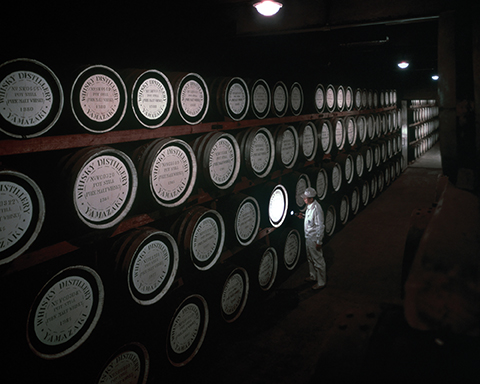
Yamazaki operates with both wooden and stainless steel fermentation tanks. It uses different yeasts, depending on the final flavour profile sought, a dozen pot stills of varying shapes and sizes, and a wide range of oak types and cask formats for ageing. These include 180-litre roasted barrels, 230-litre hogsheads, American oak puncheons, Spanish oak casks and even casks made from Mizunara (Japanese oak).
The 12-Year-Old matures in a mix of ex-bourbon casks and American oak, with a touch of whisky that has spent time in ex-oloroso casks and Mizunara oak. The 12-Year-Old is a wonderful whisky. Notes of honey, cinnamon and peach, with a hint of toffee. Complex. This is great stuff. The merest whiff of white chocolate. There is a notable spirituous character, but it is so well balanced and delightfully smooth. Terrific length. For a score, an easy 96. Love this whisky. What a sad day to have to acknowledge that it is likely to become a whisky reserved for special occasions! Perhaps my mate was right.